


This morning, Wix reported its Q2 2026 results.
Going into the report, I said I wanted to see two things: stabilization in the core business, meaning unchanged guidance from the June update, and continued momentum at Base44.
The first was confirmed explicitly. And while management didn’t disclose Base44’s ARR, everything they said suggests the business continues moving in the right direction.
The market appears to agree, with the stock reacting very positively (a welcome change from the previous two reports). The earnings call wasn’t perfect, and we’ll get to that shortly, but the market had been pricing Wix as a declining company, and that’s clearly far from the case.
Let’s go through it.
Financial Highlights
Revenue of $563.1M vs. $552.6M est. (+15% YoY, +14% cc)
A slight acceleration from Q1’s 14% YoY growth (+12% cc). This marked the fifth consecutive quarter of accelerating revenue growth, not exactly what you would expect from a “dying business.”
Total Bookings of $569.1M (+12% YoY, +11% cc)
Reported growth decelerated from 15% in Q1, but constant-currency growth remained unchanged at 11%, meaning the slowdown was driven by FX.
Management attributed the gap between bookings and revenue growth primarily to the Partners business. My interpretation is that the ongoing shift from traditional Wix products toward Base44 is temporarily weighing on new bookings, while revenue remains supported by contracts signed in previous periods. However, management didn’t provide a detailed bridge between the two metrics. The gap may also partly reflect Base44’s more monthly-oriented subscription mix compared with Wix’s more annual-heavy customer base. Monthly subscriptions contribute less upfront to bookings, so Base44’s growth can support revenue without generating the same immediate uplift in bookings.
Total Consolidated ARR of $1.963B (+15% YoY, consistent with Q1)
With management no longer providing regular updates on Base44’s ARR, the split is harder to estimate this quarter.
Management told us a couple of quarters ago that it would stop reporting standalone Base44 figures regularly and would instead provide updates when the business reached important milestones. My interpretation is that this prevents investors from overreacting to quarterly shifts in the mix between the core business and Base44.
The company is increasing its investment in Base44 while reducing marketing spending in the core Wix business, although management noted that part of the decline in core spending reflects seasonality and the lapping of previous campaigns. Strategically, the shift makes sense as long as Base44’s growth more than compensates for any slowdown in the core.
If we assume Base44 ended Q2 at ~$180M in ARR, consistent with its previous trajectory of $100M in early March and $150M in mid-May, the implied core Wix ARR would be ~$1.783B. Compared with Wix’s total ARR of ~$1.7B a year ago, that would suggest growth of ~5%. However, this is only a rough estimate and not something I’d rely on entirely.
Overall, considering that sales and marketing expenses decreased by ~9% QoQ, it’s encouraging to see total revenue growth accelerate while ARR growth remained stable, regardless of the mix.
Non-GAAP Gross Margin of 67%, down from 70% YoY but slightly better QoQ (Creative Subscriptions at 80%, Business Solutions at 33%)
Non-GAAP Operating Income of $64.8M (12% margin, down from 22% YoY but up from 5% QoQ)
Non-GAAP Net Income of $68.2M (12% margin, up from 8% QoQ), or $1.59 per basic share / $1.39 per diluted share vs. $1.13 est.
GAAP Net Loss of $76.4M, or -$1.78 per share
The GAAP loss was driven by $27.1M of restructuring charges and $41M of non-cash Base44 earnout accruals. No cash earnout payments were actually made in the quarter.
As I noted last quarter, growing earnout accruals are a positive signal: they exist because Base44 keeps tracking toward the high end of its performance targets.
Free Cash Flow excluding restructuring costs of $61.2M, or 11% of revenue
Wix’s quarterly FCF can be lumpy due to working capital timing. More importantly, management maintained its full-year high-teens FCF margin outlook, as discussed below.
The company ended the quarter with $960.9M in cash and equivalents against $1.63B in debt, after spending $1.62B on share repurchases during the quarter.
Other KPIs:
Creative Subscriptions Revenue of $398.4M (+15% YoY), bookings $405.8M (+11%)
Business Solutions Revenue of $164.7M (+14% YoY), bookings $163.3M (+13%)
Transaction Revenue of $71.5M (+12% YoY), with take rate expanding to 1.96%
GPV of $3.6B (+3% YoY)
Partners Revenue of $213.8M (+17% YoY), or 38% of total
~317M registered users at quarter end
4,371 employees at quarter end, down 906 QoQ
Creative Subscriptions was the clear exception, accelerating to 15% YoY, likely helped by Base44’s growing contribution. Most of the other metrics decelerated, reflecting the softer trends in the core business and Partners segment that management had already flagged in its June update.
Overall, the mix was broadly in line with expectations: Base44 supported Creative Subscriptions growth, while softness in the core weighed on most of the other metrics.
The reality is that, even with an increasing focus on Base44, most core KPIs still posted double-digit growth, which is much better than what the market had been pricing in. When a business is priced for decline, a quarter like this is more than enough to surpass expectations.
Outlook (maintained across the board following the June update):
Q3 Revenue growing at a low-double-digits percentage YoY
FY2026 Revenue growing at a low-to-mid teens percentage YoY (implying ~$2.26-2.33B)
FY2026 Bookings growing at a low-teens percentage, continuing to lag revenue on Partners softness
FY2026 FCF margin, excluding acquisition and restructuring costs, in the high teens (implying roughly ~$385-440M)
Non-GAAP Operating Margin stepping up in H2 vs. H1, helped by two points of gross margin improvement from Base1, lapping the Super Bowl spend, and realignment savings, partially offset by FX headwinds and reinvestment into Base44
Two notes from the Q&A: Lior explicitly said he doesn’t expect Q4 revenue growth to accelerate from Q3, so investors shouldn’t model a second-half hockey stick.
I didn’t love this part of the call, as I had hoped Base44 would drive continued acceleration throughout the year. However, its contribution to the consolidated numbers is still relatively small, so simply offsetting the slowdown in the core would already be a positive outcome and better than what the market appears to be pricing in. As Base44 becomes a larger share of the business, I’d eventually like to see revenue growth accelerate beyond the current 15% rate in 2027, but it’s still too early to say whether that will happen.
With ~49M diluted shares post-tender, the maintained FCF outlook implies $8-9 in FCF/share this year, meaning the stock trades at roughly 7-8x FCF even after today’s 17% rally.
Margins, Costs, and the Realignment
The margin story remains central to understanding this quarter.
Total non-GAAP gross margin came in at 67%, down three percentage points YoY but slightly higher sequentially. The composition is important: management said margins in the core Wix business remained stable compared with last year, while the consolidated decline reflected the continued scaling of Base44 and its elevated AI compute costs. Creative Subscriptions margin held at 80% for the second consecutive quarter, while Business Solutions margin improved slightly to 33%.
The forward-looking picture is considerably more encouraging. With Base1 now live, management expects Base44’s non-GAAP gross margin to reach 60% in the second half, up from near zero entering the year. That improvement should contribute roughly two percentage points of consolidated gross margin expansion in H2 compared with H1. I’ll discuss the drivers behind this in the Base44 section.
On operating costs, non-GAAP sales and marketing expenses were $173.1M, up 67% YoY and representing 31% of revenue, compared with 21% a year ago. However, that was down from 35% of revenue in Q1 as the Super Bowl campaign rolled off. The elevated spending remains deliberate: Wix continued increasing its investment in Base44 to capitalize on strong top-of-funnel demand, while inference and compute costs associated with free Base44 users also rose sequentially. Management plans to reinvest the gross margin savings generated by Base1 into additional sales and marketing, meaning spending should remain elevated through the second half as Wix prioritizes market share capture over near-term margin maximization.
That increased Base44 investment should be partly offset by lower marketing expenses in the core Wix business. Management also expects R&D expenses to remain roughly stable in H2, as the strengthening Israeli shekel will offset some of the savings generated by the organizational realignment. Even with those investments and FX headwinds, consolidated non-GAAP operating margin is still expected to improve in the second half.
On the realignment: Headcount ended the quarter at 4,371, down 906 employees from Q1, a reduction of ~17% in a single quarter following the changes implemented in early June.
Since my initial research, I’ve argued that Wix didn’t need such a large employee base to execute its strategy and that headcount efficiency was one of the clearest levers available. That process is now underway, with resources being redirected toward the areas producing the strongest returns.
The realignment also included the wind-down of Inkfrog. Management said the subsidiary made a moderate contribution to GPV but generated relatively weak monetization, so removing it should improve the mix toward higher-value GPV and support the overall take rate.
The restructuring resulted in $27.1M of charges during the quarter, including ~$8.5M in cash costs. That’s a one-time expense I’m comfortable accepting in exchange for a structurally leaner cost base, particularly when the savings are being redirected toward Base44 and other higher-return opportunities.
Overall, the quarter reinforces the idea that Wix isn’t simply cutting costs to protect profitability. It’s removing lower-return spending while preserving investment in the products it believes can drive the next phase of growth. The near-term result may not be maximum operating leverage, as much of the savings will be reinvested, but the underlying cost structure is becoming more efficient in the areas where it should.
Core Wix Business
The core did what it needed to do: it decelerated as management had already signaled in the June update, but it didn’t deteriorate beyond that. The softer bookings and Partners trends were expected, not a new negative surprise. At the consolidated level, guidance remained intact as Base44 is increasingly offsetting the slowdown elsewhere in the business. That distinction matters. A deceleration in the core was always possible, and given the shift in spending and product mix, arguably likely. What the stock has been pricing in, however, is something much worse: an outright decline.
My thesis has never depended on the traditional Wix engine reaccelerating in the near term. I view it as a durable, cash-generative platform that can fund Base44 while the newer segment compounds at a much faster rate. Management doesn’t provide a clean standalone core growth figure anymore, but the disclosed platform metrics remain mostly in double-digit growth territory, which looks far more like a maturing business than a shrinking one.
The installed base is central to that durability. Wix ended the quarter with ~317M registered users, and the platform sits inside websites, domains, payments, marketing, commerce, and day-to-day business workflows. A meaningful base of users and businesses is deeply embedded and unlikely to migrate overnight. Harmony’s improving conversion and the solid performance of recent cohorts also suggest that Wix is still finding ways to expand that base rather than simply harvesting it.
Partners remains the messiest part of the picture, but management’s commentary suggests that at least some of the pressure is transitional rather than pure customer loss. Some agencies that previously built $1,000 websites are now using Base44 to build $15,000-30,000 applications for clients. It’s too early to know how much of that activity is additive versus cannibalistic, but Wix is positioning itself to own the workflow either way. If a partner moves from creating a website on Wix to building a larger application through Base44, the product mix changes, but the relationship doesn’t necessarily disappear. More importantly, Base44 is compensating for that pressure at the consolidated level. That’s how we need the portfolio to work: the mature engine generates lots of cash, while the hyper-growth segment absorbs investment and preserves the company’s overall growth. Obviously, the ideal scenario would be an acceleration in both segments, but if that were happening, the company wouldn’t be trading at a single-digit FCF multiple.
The broader platform strategy is visible in Wix Headless. By allowing AI-generated front ends from tools such as Codex Enterprise, Claude Code, and other agentic environments to connect directly to Wix’s commerce and business infrastructure, Wix is positioning itself as the underlying operating layer. In other words, the company continues to expand the number of ways customers can access and build on its platform, even when the front end is created elsewhere.
We don’t need the core business to be a growth engine for the thesis to play out. We need it to remain durable, cash-generative, and relevant enough to support Base44 without collapsing underneath it. This quarter reinforced that view. The deceleration appeared where management said it would, Base44 helped offset it, and the evidence remains far more consistent with a mature growth business than a declining one. The key now is for Wix to maintain this balance over the coming quarters.
Base44
Management said a couple of quarters ago that it would stop reporting standalone Base44 ARR, which I find a bit frustrating.
The most logical explanation, in my view, is that management doesn’t want the market to panic if Base44 continues growing while the core business slows, particularly as some of the company’s focus and marketing spend shifts from one side to the other.
What management did say is that the trajectory is “trending in similar manners as before.”
The newest cohort is outperforming the previous one, renewal activity led overall growth, and more new and existing users are choosing annual plans as they increasingly trust Base44 for their software needs. Management also shared that Base44 now hosts more large enterprises than Wix itself, while usage is split roughly 60% business and 40% personal.
I’d still rather have the actual number, but the qualitative picture remains consistent with the trajectory we’ve been following since Base44 had $3M in ARR at the time of the acquisition.
Two retention data points are worth watching in future quarters. First, Base44’s earliest annual cohorts are only now approaching their first renewal window, so we should get meaningful renewal data within the next quarter or two. Second, monthly retention remains naturally below Wix’s, given that Base44 is only about a year old and operates in an entirely new category, but it has supposedly been improving almost every month.
The real news, however, was the economics.
In late June, Base44 launched Base1, its proprietary LLM, built on an open-source foundation and trained on Base44’s data from tens of millions of user interactions. This made Base44 the first app-creation platform to launch its own model.
The result is significant: Base44’s gross margin, which was near 0% entering the year, is now expected to reach approximately 60% in the second half, with total AI costs across both free and paid users falling to 30-40% of Base44 bookings. Lior confirmed that the margin improvement is already visible within the guided range rather than merely being a forecast. Avishai was direct about the mechanism: Base44’s models generate enormous amounts of code per prompt, and the team continuously trains Base1 on what actually works. As a result, it now produces better outcomes than frontier models for Base44’s specific use case, at a dramatically lower cost.
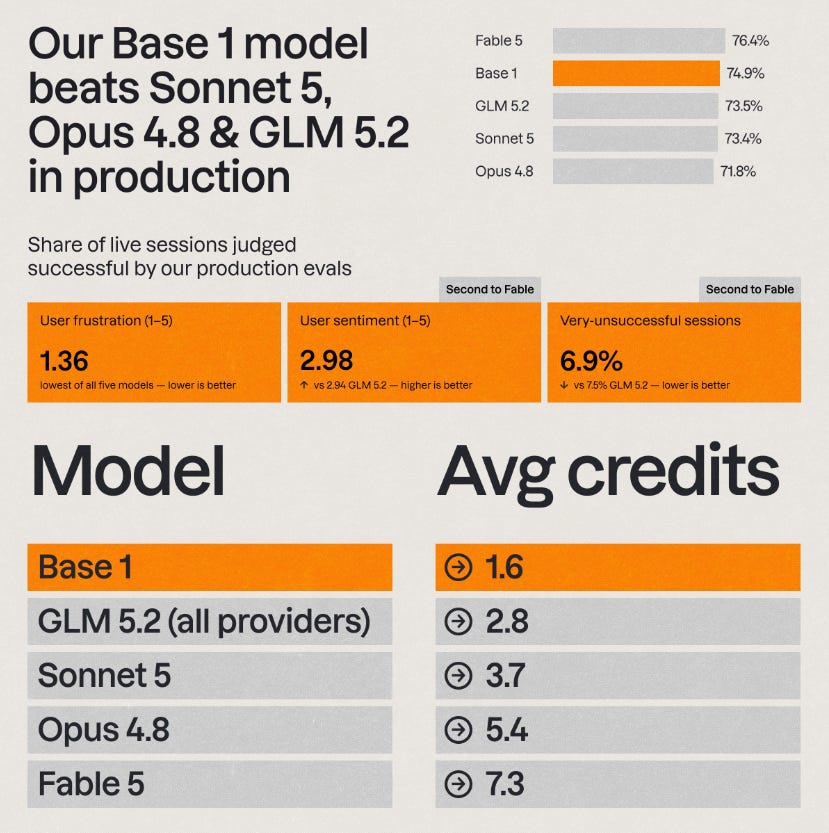
Later in the day, Maor Shlomo published production benchmarks supporting those claims. In live sessions evaluated using Base44’s production tests, Base1 achieved a 74.9% success rate, essentially matching Fable 5 at 76.4% and outperforming Sonnet 5, Opus 4.8, and GLM 5.2. At the same time, it consumed ~78% fewer credits than Fable 5, averaging 1.6 credits compared with 7.3. It also recorded the lowest user-frustration score among the five models tested.
A purpose-built model delivering near-frontier quality for its specific use case at a fraction of the cost captures the entire margin story in a single chart. It also makes the 60% gross margin guidance look realistic rather than aspirational.
To me, this was the highlight of the quarter.
As I’ve been saying since my first article on Wix, the rapid progress of open-source models is bullish for Base44 because inference costs were the single biggest source of pressure on its margins. The company has now confirmed that in the most concrete way possible. The argument that “vibe coding platforms will never make money” just lost its centerpiece.
Strategically, Base1 also follows the Harmony playbook. Wix now has a portfolio of purpose-built LLMs, each trained on proprietary data that, as Avishai explained, carries forward and strengthens every future model the company builds rather than benefiting an external vendor’s model.
The CEO also shared a thoughtful perspective on the competitive dynamics. Asked whether Base1’s improvement depends on continued progress in open-source models, he said it would benefit from such progress, but that “the vast majority of the value will come from what we do.” Base1’s advantage lies in solving Base44’s specific challenges, such as turning poorly specified prompts from non-developers into working applications, rather than competing on general intelligence.
Product velocity hasn’t slowed either. This quarter alone brought AI-powered Workflows, which add rich triggers, conditions, approvals, and connector events to Base44 apps, with AI agents able to manage automations inside customer applications. The company also launched Verification Mode, which automatically validates and corrects implementations, expanded its Figma integration and design capabilities, and continued building enterprise-grade governance through SSO improvements, publishing permissions, self-serve enterprise plans, and broader compliance integrations.
These are the foundational capabilities Base44 needs to serve organizations with more complex requirements, which matters given that it already hosts more large enterprises than Wix itself.
Notably, management isn’t allowing the Base1 savings to fall to the bottom line yet. The entire gross margin improvement will be reinvested into Base44 sales and marketing through the rest of the year, while the company moderately extends its TROI threshold. Nir was clear that there’s no plan to keep raising it: the framework remains disciplined, and increasing annual-plan adoption can shorten payback periods by allowing Wix to collect cash sooner. Still, with the unit economics structurally improved and the category continuing to take shape, aggressive investment is the right approach. Management said demand for Base44 remains elevated and that capturing market share remains its top priority.
Base44 is evolving from a hypergrowth startup into a real business. As management put it, it now has more or less the same profitability as many other software companies, with further room to improve.
In my opinion, the main reason the market has overlooked Base44’s potential has been the broader concern around margins. These developments represent meaningful progress and show that the company always had levers available to improve profitability.
The thesis seems to remain on track as it relates to Base44. The only thing still missing is the ARR number, and I sincerely hope we receive an update soon.